Guides
Commercial Kitchen Ductwork Pricing: How Bids Are Built
Commercial kitchen ductwork pricing depends on hood and exhaust scope. See US planning ranges for components and how labor, clearances, and code shape bids.
What to take away
- Kitchen exhaust is priced per linear foot of hood, per pound or foot of grease duct, and per fitting, not by building square footage.
- Type 1 hood duct cost rises fastest with fire-rated wrap, clearance, and access doors.
- Cleaning contracts and duct replacement are separate scope items, beyond the initial hood installation.
- Published HVAC wage data can inform labor assumptions, but loaded bid labor also includes burden, truck, supervision, and warranty.
- For context, Canadian projects add provincial code review that can change wrap and clearance details.
Why Kitchen Exhaust Prices Differ From Comfort Ductwork
Commercial kitchen ductwork pricing differs from comfort ductwork because restaurant exhaust carries grease, heat, and smoke. The two systems are priced on different units. Supply and return duct is often galvanized sheet metal with slip joints, priced by the square foot of surface area.
Grease duct is welded, sloped back toward the hood, and wrapped or enclosed. Contractors price it by weight from the fabricator and by linear foot for installation. That split alone changes the shape of a bid.
Restaurant scope also sits on top of whatever the base building already pays. Our guide to ductwork pricing for commercial buildings explains the square foot and per ton bands that cover the rest of the shell.
What Contractors Price Per Linear Foot Of Hood
Hood pricing usually covers the canopy, the filters, and the first length of duct. Everything past that point moves to a per foot line. A fire suppression tie in, a make up air unit, and a utility distribution manifold each add cost.
Hood Pricing Line Items
Line item
- Type 1 hood canopy
- per linear foot
- Grease duct
- per pound or foot
- Fire rated wrap
- per linear foot
- Access doors
- each
- Exhaust fan
- each
Pricing basis
- Type 1 hood canopy
- filter count, gauge
- Grease duct
- weld type, slope
- Fire rated wrap
- rating hours, method
- Access doors
- panel size, location
- Exhaust fan
- airflow, static pressure
Main cost driver
- Type 1 hood canopy
- Grease duct
- Fire rated wrap
- Access doors
- Exhaust fan
A longer hood holds more filter slots. More slots means more airflow, which drives duct size, fan size, and roof support. Those three items often cost more than the hood itself. The next step is covered in Ductwork Cost per Linear Foot Insulated.
| Line item | Pricing basis | Main cost driver |
|---|---|---|
| Type 1 hood canopy | per linear foot | filter count, stainless gauge |
| Grease duct | per pound or per linear foot | weld type, gauge, slope |
| Fire rated wrap | per linear foot | rating hours, enclosure method |
| Access doors | each | panel size, location |
| Exhaust fan | each | airflow, static pressure |
Typical US contractor planning ranges are $400 to $900 per linear foot for a Type 1 hood canopy, $75 to $180 per linear foot for installed grease duct, $30 to $70 per linear foot for fire rated wrap, $150 to $450 each for access doors, and $1,500 to $6,500 each for exhaust fans.
Pricing Factors For A Twelve Foot Type 1 Hood
A twelve-foot hood is not priced as twelve identical units. Contractors consider the canopy and connected exhaust components rather than multiplying a single per-foot rate across the job. The listed ranges above cover several components, while project scope determines the final bid.
Pricing a Twelve Foot Hood
- Measure hood length, filter count, cooking output
- Route duct, count elbows, offsets, penetrations
- Confirm fire rating, pick wrap system
- Place access door at every direction change
- Price fan, curb, electrical disconnect
- Add testing and balancing
Each step can move the total by more than the hood length does.
Fire Rated Wrap, Clearances, And Code Review
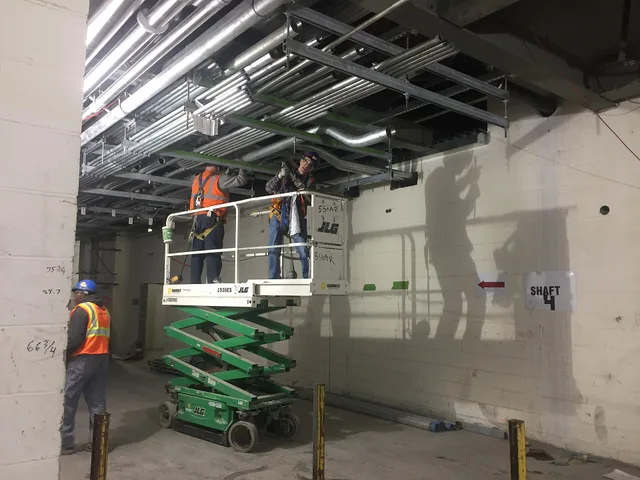
Grease duct must maintain clearance from combustibles unless it is protected by a listed enclosure or wrap assembly. NFPA 96 covers commercial cooking exhaust, and factory-built grease ducts may be listed to UL 1978. The wrap or enclosure is not a generic blanket: installers follow its listing and instructions, and inspectors check clearance at every penetration.
Insulated duct assemblies elsewhere in the building follow NFPA 90A, which covers installation and insulation for air conditioning and ventilating systems. Kitchen exhaust is governed separately by NFPA 96 and applicable locally adopted mechanical and fire codes, including the International Mechanical Code (IMC) and International Fire Code (IFC) where those codes are adopted. The same contractors wrap both, and the labor overlaps.
Materials, Standards, And What Gets Specified
Material specifications define the required properties of duct insulation, wrap, and liner. For grease duct, the selected listed assembly and its installation instructions determine which materials and substitutions are acceptable. A specification that limits substitutions can raise the material line while lowering the risk of a failed inspection.
Grease duct itself is carbon steel or stainless. Stainless resists the acids in cooking grease longer, and corrosion attacks welds and seams before it reaches flat sheet.
Cleaning Cycles And Replacement Timing
Kitchen exhaust cleaning is priced by linear foot, by access panel count, and by how much grease has hardened. Ducts with doors at every change of direction clean faster and cost less per visit. Ducts without them get opened by other means, then repaired.
Replacement decisions usually come from three signals. Grease has built up behind the wrap. Welds show corrosion. The fan no longer holds airflow after cleaning. A hood can be reused while the duct behind it is replaced.
Labor Rates And Who Does The Work
The Bureau of Labor Statistics publishes wage data for heating, air conditioning, and refrigeration mechanics and installers. That data is the starting point for loaded labor in a kitchen exhaust bid. Contractors add burden, truck, supervision, and warranty. BLS reports a median of $28.76 per hour and $59,810 per year for HVAC mechanics and installers as of May 2024.
Sheet metal workers fabricate and hang the duct. Pipefitters run gas to the cooking line, sometimes under the same contract. The BLS figures above are for HVAC mechanics and installers, not sheet metal workers or pipefitters, so they should not be treated as wage rates for every trade on the bid.
Canada And Provincial Requirements
Canadian projects follow provincial rules. The Ontario Building Code sets installation requirements that inspectors verify on site, and wrap thickness and clearance details can differ from a US job. Budget for a code review before the duct is fabricated.