Guides
Hire reliable HVAC contractor staff with a scored assessment
Hire reliable HVAC staff with a scored assessment: six behavioral questions, a paid fault-finding exercise, three verifications and a weighted decision.
What to take away
- Reliability is a behavior, so test for behavior. Ask what someone did, not what they would do.
- Use the same questions, in the same order, for every candidate. It is fairer and it produces comparable answers.
- A short practical exercise tells you more than an hour of conversation, and it has to be paid and safe.
- Verify permissions with the issuing body. A card in a wallet is not verification.
- Score against written criteria before you discuss the candidate, or the loudest opinion in the room decides.
Guidance on running a hiring process. Employment obligations vary by jurisdiction and change, so confirm your practice with the relevant agencies before you use it.
Four stages, one weighted score
Run every candidate through the same four stages, and score each one against criteria written beforehand. The table shows a weighting for a technician role. Change the numbers to fit the role, but write them down before the first interview.
The decision
| Stage | Weight | Full marks |
|---|---|---|
| Practical exercise | 40 | Found the fault, explained it, followed the safety steps |
| Reference calls | 25 | A former employer would take them back, with specific examples |
| Interview answers | 20 | Past actions they took, not opinions about how they work |
| Verification | 15 | Certification confirmed with the issuing body, driving record checked |
Weight the exercise and the reference calls heavily, and the interview least, because it measures interviewing. The levels of the role, from helper upward, are set out in the hiring and training guide, so the assessment only needs the tasks the person will do alone on day one.
Stage one: the same six questions
Ask behavioral questions in the same order and record the answers on the same form. Past behavior is evidence, and an opinion about how someone works is not. Six questions that work in this trade:
Six Behavioral Interview Questions
- Describe a fault you could not diagnose
- Tell about a time you stopped a job
- Describe a job where customer was unhappy
- What do you check before leaving site
- Tell about a mistake that cost money
- What work do you not want to do
The same questions, every time
- Tell me about a job you finished without help. What did you check before you left?
- Tell me about a time you stopped work on a system. What told you to stop, and who did you tell?
- Tell me about a repair that came back. What did you find, and what did you change?
- Tell me about a customer who was unhappy with the work or the price. What did you say?
- Tell me about a mistake you made in the last year. What did you do differently on the next job?
- Tell me about a time you explained a repair to someone who does not know the trade.
Question two is the most predictive. Technicians who know when to stop, and who tell someone, are the ones you can send out alone. Question five separates candidates who reflect from candidates who narrate.
Take notes as they speak, and score afterward against the criteria you wrote before the interview. For question four, listen for how the person would have handled a customer complaint in your firm.
Asking everyone the same questions is also the simplest way to keep the process even-handed, and the EEOC says the law forbids discrimination in every aspect of employment.
Stage two: a paid practical exercise
Give each candidate an hour or two, paid, on a real piece of equipment in a controlled setting, never on a customer's system. Say in advance what the exercise is and how it will be assessed.
What to Watch in Practical Exercise
- Sets up safely
- Measures rather than guesses
- Reads manufacturer documentation when unsure
- Keeps the area clean
- Handles unexpected problems
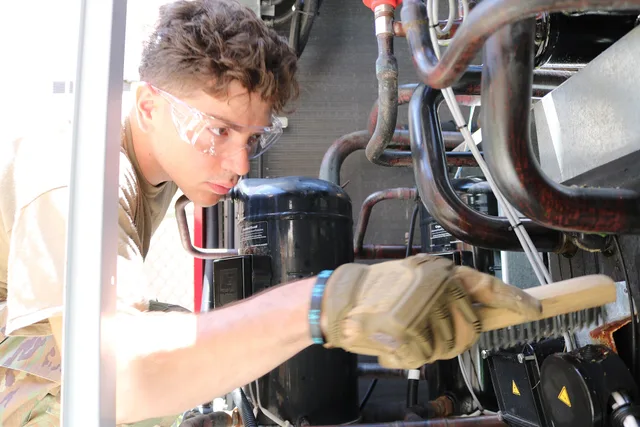
One exercise that works is a split system in your own shop, with a fault you set beforehand, such as a failed run capacitor or a thermostat wired to the wrong terminal. The candidate gets ninety minutes, a gauge manifold, a multimeter, a thermometer and the unit's service history.
The pass criteria are written down: they find the fault, say what the repair involves, and write down what they did not check and why. Give every candidate the same task and the same conditions, and keep safety supervision on it, because a hiring exercise is still work.
Offer the same instruments your technicians carry: a gauge manifold, a digital multimeter, a vacuum gauge and a refrigerant scale, as listed in the equipment and setup guide. Watching someone use unfamiliar instruments tells you about learning, which is more useful than watching them use familiar ones.
Score the exercise on the written criteria, not on speed. A candidate who works steadily, explains the fault clearly and records what was left unchecked is easier to send out alone than one who finishes first and says little. Record the scores the same day, while the details are fresh.
Stage three: verify, do not just inspect
Verify three things, and none of them by inspecting a document alone. Check certifications and registrations with the issuing body. Check the driving record where the role involves a company vehicle, on whatever basis your jurisdiction and your insurer permit. Call references rather than reading them.
Three Verification Steps
- Certifications checked with issuing body
- Driving record where company vehicle involved
- References called, not read
Refrigerant certification sits under a federal program run by the Environmental Protection Agency and attaches to the person. Under Section 608, technicians are required to pass an EPA-approved test, and the tests are specific to the type of equipment. Ask which type the candidate holds.
The state layers around that certification are in the licensing and compliance guide.
When you call a reference, ask former employers three specific questions: what work did they do unsupervised, how did they handle a job that went wrong, and would you have them back. The pause before the third answer is often the answer.
Whatever checks you run, run them for every candidate at the same stage, and follow the requirements that apply to them where you operate.
Stage four: score, then discuss
Score before you discuss. Each interviewer completes their form independently, then you compare. Discussion first turns a hiring decision into a popularity contest. A written score also gives you something to point to if a candidate asks why the offer went elsewhere.
Compare the forms stage by stage, not only the totals. A candidate who did well in the interview but missed the fault in the exercise has told you something the total hides. When two interviewers disagree, go back to the written criterion, not to the louder voice.
Then make the offer in writing, with the role, the pay, the hours and the classification. Onboarding follows in the staff training checklist.
Before the first candidate walks in
- Day-one tasks for the role written down
- Six questions and the answer form printed
- Exercise unit faulted, tested and the pass criteria written
- Safety supervisor named for the exercise
- Weights and full-marks descriptions agreed by every interviewer
- Reference questions and the verification order fixed
Common questions
Should I hire for attitude and train for skill?
For helper and apprentice levels, largely yes, provided you have supervision capacity. For a role that must work unsupervised on a customer's system tomorrow, skill and permissions are not optional.
Should the exercise really be paid?
Yes. A paid hour or two on equipment in a controlled setting is fair to the candidate, and it keeps the exercise a defined piece of work rather than a free day on the job.
Is a trial period a good idea?
A structured first ninety days with review points works better than an ambiguous trial. Write down what will be assessed and when, and hold the reviews.
What if the best candidate lacks the certification?
Then you are hiring at a lower rung with a training plan, and the offer should say so, including who supervises them and what work they may not do until the certification is held.