Guides
HVAC contractor licensing requirements: six layers
A six-layer map of HVAC contractor licensing requirements and compliance: who owns each layer, what each one controls, and the document that proves it.
What to take away
- Six layers, different bodies, and different kinds of evidence. HVAC contractor licensing requirements, permits and inspections do not sit in one place, and confusing them is why compliance feels unmanageable.
- Only the refrigerant layer is federal and identical everywhere. Safety and employment law set a federal floor that states can raise, and everything else changes at a state or city line.
- A permission attaches either to a person or to a business, and knowing which one is the difference between hiring a solution and being the solution.
- Compliance failures here are visible in front of customersa failed inspection, a job that cannot be permitted, a technician who may not touch the refrigerant.
- Each layer ends in a document that proves the positiona license, a certification, a permit and inspection record, a training log, a payroll record, a registration.
This is a map of who owns each layer, not legal advice. Confirm each point with the body that issues the permission, and take advice on anything consequential.
The six layers
| Layer | Who owns it | What it controls | Attaches to |
|---|---|---|---|
| Contractor licensing | State board, sometimes a city or county | Holding out as a contractor, pulling permits, the scope you may sell | Usually a named person, sometimes the business |
| Refrigerant handling | Environmental Protection Agency | Who may handle refrigerant and how it is recovered | The technician |
| Mechanical code and permits | Local building or mechanical code official | How the work must be done and inspected | The job |
| Workplace safety | Federal and state occupational safety agencies | How your people work and what you must have in place | The employer |
| Employment | Federal and state labor and equal opportunity agencies | Pay, hours, classification, hiring practice | The employer |
| Business registration and tax | State and federal revenue and registration bodies | Existence, tax accounts, records | The business |
Everything a customer, an inspector or a claims adjuster will ever ask you about sits in one of those rows.
Six regulatory layers and owners
Layer
- Contractor licensing
- State board
- Refrigerant handling
- EPA
- Mechanical code
- Local code official
- Workplace safety
- OSHA and state
- Employment
- Labor agencies
- Business registration
- Revenue bodies
Who owns it
- Contractor licensing
- Holding out, permits
- Refrigerant handling
- Handling refrigerant
- Mechanical code
- How work is done
- Workplace safety
- How people work
- Employment
- Pay, hours, hiring
- Business registration
- Existence, tax
What it controls
- Contractor licensing
- Named person
- Refrigerant handling
- Technician
- Mechanical code
- The job
- Workplace safety
- Employer
- Employment
- Employer
- Business registration
- Business
Attaches to
- Contractor licensing
- Refrigerant handling
- Mechanical code
- Workplace safety
- Employment
- Business registration
Layer one: the contractor license
This is the layer with the most variation and the most confident misinformation around it.
Four questions for the licensing board
- Which classification covers the work I intend to sell?
- Does it attach to an individual or the business?
- What experience or examination is required?
- What must be displayed, carried or advertised?
Ask the state contractor licensing board four questions in writing. The first: which classification covers the work I intend to sell?
The boards differ, but the shape of the thing is the same. California licenses the trade through the Contractors State License Board under the C-20 Warm-Air Heating, Ventilating and Air-Conditioning classification, and renews contractor licenses on a two-year cycle. Texas licenses air conditioning and refrigeration contractors through the Texas Department of Licensing and Regulation. Florida licenses air conditioning contractors through the Department of Business and Professional Regulation.
The classification, not the title on the van, decides what you may sell. The license application goes to the board, and renewal intervals and any continuing-education hours are set by the board and printed on the renewal notice rather than assumed.
Two more states show the spread. Arizona licenses contractors through the Registrar of Contractors, and North Carolina routes heating and air conditioning licensing through a board that handles only plumbing, heating and fire sprinkler contracting. Some states license the trade statewide, some leave it to city and county registration, and a few do both. The method is the same everywhere: the board publishes its own application, classification list and exam outline, so search the state name together with "air conditioning contractor license" and work from the board's own page.
Does it attach to an individual who must hold a defined business position, or to the business itself?
What experience or examination is required, how long does the process take, and what must be displayed, carried or included in advertising?
The last question matters more than people expect. Requirements about license numbers on vehicles, quotes and advertisements are common, and the failure is public.
When a city or county adds its own registration on top of the state one, the permit desk usually tells you.
Introduce yourself there before your first job, not during it.
Layer two: refrigerant, the one that does not vary
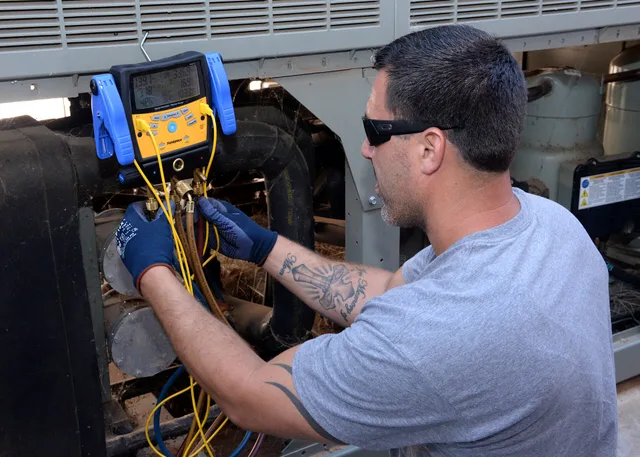
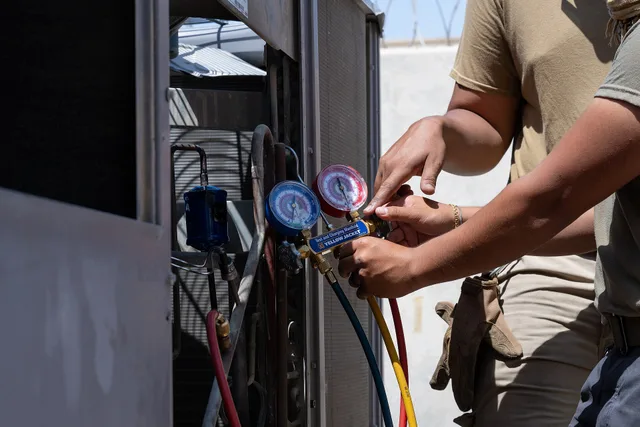
Refrigerant handling is a federally regulated activity. The Environmental Protection Agency runs a technician certification program, described at the EPA Section 608 technician certification pages, and the requirement applies wherever you work.
Three practical consequences. The certification attaches to the person, so it moves when they do. Recovery, handling and record obligations attach to the work, so they are not satisfied by owning the equipment. And the details change over time as the regulations are updated, so read the current pages rather than relying on what you were told when you certified.
The certification comes in four types, and the type has to match the equipment you service: Type I for small appliances, Type II for high-pressure systems, Type III for low-pressure appliances, and Universal, which covers all of them. The exam is given by EPA-approved certifying organizations rather than by the EPA itself, and once you hold the certification it does not expire.
The records that sit alongside the card — what was recovered, what was added, where it went — belong to the job rather than to the person, and they are the part a site visit actually asks to see.
If any part of your service list touches a refrigerant circuit, this layer is a precondition for selling it at all, which is why it appears in the competence gate in the services and packages guide.
Layer three: the code official and the permit
Your relationship with the local mechanical code official is a working relationship, not a compliance box.
The instrument is a permit. In a house or a small commercial job that usually means a mechanical permit, sometimes issued alongside a building permit. The application goes to the local building department, which the code calls the authority having jurisdiction, and the work is then inspected in stages: a rough-in inspection before ducts and equipment are closed up, and a final inspection before sign-off. Duct leakage or pressure testing is often part of that final sign-off.
Most US jurisdictions work from the International Mechanical Code or the mechanical chapters of the International Residential Code, as adopted and amended locally. Ask the permit desk which edition your city or county is enforcing, because that is the version an inspector carries.
Four things to settle with the code official
- Which code edition is enforced here?
- What must a change-out permit application contain?
- What triggers an inspection and how is it scheduled?
- What are the common local inspection failures?
Build permit and inspection time into your quotes rather than absorbing it. A trip back to meet an inspector is an hour of capacity, and firms that price it stop resenting it.
Layer four: safety, which is a program not a cupboard
The employer's obligation is to run a safety and health program, not to own protective equipment. What that means in practice is described in the OSHA guidance on safety and health programs.
For this trade the recurring subjects are work at height, electrical safety and lockout, confined and restricted spaces, respiratory protection around insulation and duct work, heat exposure in attics and on roofs, and safe handling of pressurized equipment.
The standards behind those subjects are specific. 29 CFR 1910 covers general industry and 29 CFR 1926 covers construction, with lockout/tagout at 1910.147, respiratory protection at 1910.134, permit-required confined spaces at 1910.146, and fall protection at 1926.501. Some states run their own OSHA-approved State Plan, which is the second call after the federal rules.
Two documents make the difference between a program and a claim: a written procedure for each recurring hazard, and a record that people were trained on it. Both are also what an insurer will ask for after an incident.
Layer five: employment
The moment you employ anyone, a set of obligations arrives that has nothing to do with HVAC.
Pay and hours rules for small businesses are explained in the Department of Labor compliance assistance material for small businesses. Classification is the trap in this trade: treating a working technician as a contractor because it is administratively simpler is a decision with consequences that arrive late and all at once.
The federal floor is the Fair Labor Standards Act, enforced by the Wage and Hour Division of the Department of Labor, and the same department's compliance assistance material for small businesses covers the recordkeeping. Hiring also brings Form I-9 for employment eligibility, workers' compensation coverage under state law, and state unemployment insurance registration.
Misclassification is the expensive mistake: a technician who works your hours, on your jobs, with your equipment is an employee, and the tax for the difference arrives late and all at once.
Overtime during a peak season, travel time, on-call arrangements and apprenticeship structures all deserve a written answer before the season rather than during it.
Layer six: business registration and tax
Layer six is the one the trade forgets, because nobody in the trade asks for it. It starts with the entity: an LLC or corporation registered with the state, usually through the secretary of state, plus a federal Employer Identification Number from the IRS. Then state sales and use tax registration for the parts and equipment you sell, a local business license where the city requires one, and the state tax filings that follow from having employees. Several boards also want the business itself registered separately from the qualifying individual's license.
Beyond the six layers: accessibility and public claims
Two obligations sit outside the trade layers and get missed.
If you have premises the public visits, accessibility obligations apply. The ADA guide for small businesses is a reasonable starting point for understanding what that involves, and a current position should be checked with the relevant agency because guidance is updated.
And whatever your website and vehicles say about licenses, certifications and approvals has to be accurate. A dealer program is a commercial arrangement rather than an endorsement of your competence, and describing it as approval is a claim you cannot support.
Building a compliance calendar
The reason compliance feels overwhelming is that the six layers have different records, deadlines and inspection cycles, and nobody owns the calendar.
One compliance calendar, six renewal cycles
- MonthlyReminder arrives a month early
- AnnualLicense and certification renewal
- AnnualInsurance and vehicle inspection
- QuarterlyTax filing dates
- As requiredContinuing education requirement
Put every date in one place: license renewal, insurance renewal, vehicle registration and inspection, tax filing dates, and any continuing education requirement. Insurance and vehicle registration sit outside the six layers, which is exactly why they go missing. Give each date a named owner and a reminder that arrives a month early.
Then keep the evidence in one place too. Every layer above generates a document, and that document proves the position when someone asks.
Where the equipment and vehicle side of that evidence lives is in the equipment and setup guide. Whether the market you are entering makes the whole structure worth building is the question behind the startup and market guide.
Who owns each layer inside your business
In a firm of one, you own all six and the risk is that you own none of them properly. As soon as there is a second person, assign them.
Write the layer, the body, the renewal date and the named owner on a single page. The owner is not necessarily the person who does the work: it is the person who notices when a date is approaching and who can say where the current document is kept.
The test of the page is simple. Hand it to somebody who does not work in the business and ask them to find proof that each layer is current. If they cannot, the evidence is in someone's head rather than in the business.
What non-compliance actually looks like
Not an abstract risk. Four concrete outcomes, all of which happen.
A job that cannot be permitted, discovered after the equipment is ordered. A failed inspection with the customer present. A refrigerant handling breach, which is a federal matter rather than a local one. And an insurance claim contested because a required registration or safety record was not in place.
The fourth is the one that ends businesses, because the cost is not the penalty. It is the uninsured loss.
Common questions
Can I employ someone who holds the license instead of holding it myself?
Sometimes, and it depends entirely on your state. Some boards require the qualifying individual to be an owner or officer with a defined role. Ask the board directly rather than accepting a common arrangement you have heard about.
Do I need a license for maintenance only?
That depends on how your jurisdiction defines the regulated work, and definitions vary. Refrigerant handling brings the federal layer in regardless of what the state requires.
What happens if I work in a neighboring city?
Check before you take the call. Local registration, permit requirements and even license reciprocity vary, and advertising into a jurisdiction you are not registered for is itself a problem.
How do I keep up with changes?
Subscribe to the notification lists the licensing board and code office offer, put renewals in the calendar, and reread the federal refrigerant pages annually rather than assuming nothing has moved.